
An Introduction to the Sermon on the Mount (Part 3 of 3)
[First Things]
-
New Cohorts (new date): We are launching two new discipleship bi-weekly cohorts the week of April 6, using our 1 Peter: Whole Life Discipleship for the Public Square curriculum.
-
In-person Washington-focused cohort meeting bi-weekly on Wednesday mornings at 6:30 am near Metro Center station.
-
Online ministry leaders cohort meeting bi-weekly on Saturday mornings at 7:00 am via Zoom.
-
Click here to request more information.
-
-
-
Look for The Faithful Presence Podcast to start releasing new episodes later this week.
[The Devo] The Pursuit of Happiness
1 Seeing the crowds, he went up on the mountain, and when he sat down, his disciples came to him.
2 And he opened his mouth and taught them, saying:
3 “Blessed are the poor in spirit, for theirs is the kingdom of heaven.
4 “Blessed are those who mourn, for they shall be comforted.
5 “Blessed are the meek, for they shall inherit the earth.
6 “Blessed are those who hunger and thirst for righteousness, for they shall be satisfied.
7 “Blessed are the merciful, for they shall receive mercy.
8 “Blessed are the pure in heart, for they shall see God.
9 “Blessed are the peacemakers, for they shall be called sons of God.
10 “Blessed are those who are persecuted for righteousness’ sake, for theirs is the kingdom of heaven.
11 “Blessed are you when others revile you and persecute you and utter all kinds of evil against you falsely on my account.
12 Rejoice and be glad, for your reward is great in heaven, for so they persecuted the prophets who were before you. Matthew 5:1–12
A Tale of Two Words
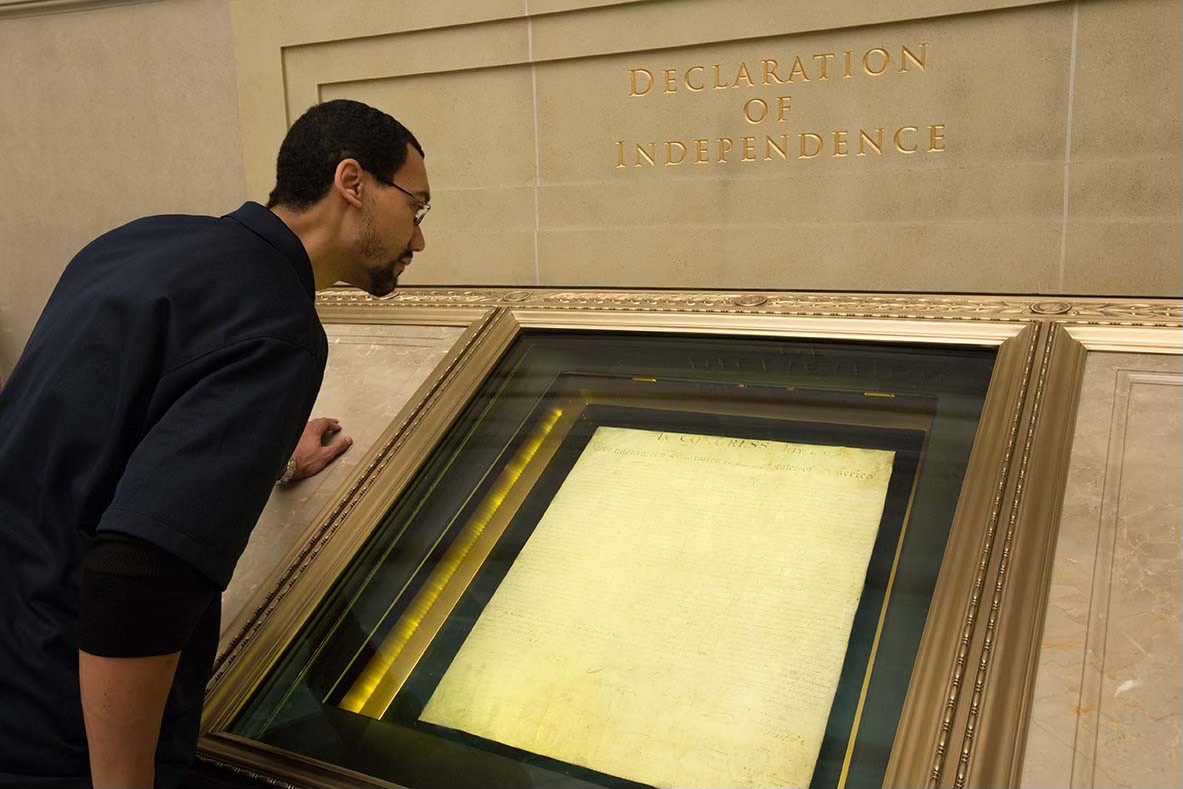
Later this year, the United States will celebrate its 250th anniversary. That date is not marked by the end of the Revolutionary War, or the ratification of the Constitution, but by the date of the signing of the Declaration of Independence, July 4, 2026. It begins with these words,
The unanimous Declaration of the thirteen united States of America, When in the Course of human events, it becomes necessary for one people to dissolve the political bands which have connected them with another, and to assume among the powers of the earth, the separate and equal station to which the Laws of Nature and of Nature’s God entitle them, a decent respect to the opinions of mankind requires that they should declare the causes which impel them to the separation.
The signers were communicating to the King of England that they sought emancipation from tyranny, from foreign occupation, from a lack of political agency, and from being treated as second-class citizens. The motivation was fueled by the belief that they were created for something better, not in the next life, but during the present one.
We hold these truths to be self-evident, that all men are created equal, that they are endowed by their Creator with certain unalienable Rights, that among these are Life, Liberty and the pursuit of Happiness.
Three simple words: life, liberty, and the pursuit of happiness. But, of course, the big question is, “What does ‘the pursuit of happiness’ mean?” That is a question humans have been struggling with for quite some time.
In the previous lesson, we looked at how Jesus’ use of blessed (Greek: makarion) would have signaled a clear connection to numerous Old Testament passages, primarily in the Psalms, familiar to the ethnically-Jewish audience. But his audience was not only ethnically Jewish, but it was also increasingly Hellenized by Greek thought. Those sitting on the mountainside to hear this sermon may not have been schooled in Greek philosophy, but they would have certainly been familiar with its key ideas - like the pursuit of happiness and the good life (Greek: eudaimonia). This is where Aristotle comes in.
Aristotle’s idea of Eudaimonia
In Nicomachean Ethics, perhaps his clearest articulation of happiness and the good life, and the virtues required to pursue and attain these ideals, Aristotle writes,
…then if this is so, and we take the characteristic activity of a human being to be a certain kind of life; and if we take this kind of life to be activity of the soul and actions in accordance with reason, and the characteristic activity of the good person to be to carry this out well and nobly, and a characteristic activity to be accomplished well when it is accomplished in accordance with the appropriate virtue; then if this is so, the human good turns out to be activity of the soul in accordance with virtue, and if there are several virtues, in accordance with the best and most complete.
Again, this must be over a complete life. For one swallow does not make a summer, nor one day. Neither does one day or a short time make someone blessed (makarion) and happy (eudaimonia). Nicomachean Ethics I.7, 1098a
When he spoke of virtue, Aristotle had in mind a “middle-way” of character not given to extremes but a life lived in balance, exemplified by reason, wisdom, courage, temperance, generosity, magnanimity, justice, friendliness, and truthfulness. His list of virtues required to pursue happiness encompassed the heart, mind, soul, and strength. One might even say that they required “whole life discipleship.”
While this study is not the place for a full treatment of Aristotle, what is certain is that his grounding for a sense of happiness and the good life came from human reason based on natural revelation. As Christian’s, we understand that both of these criteria were created by God for our enjoyment and advancement. Yet, while both are necessary for coming to true and accurate knowledge of the blessedness and happiness, they are not sufficient with divine revelation.
This is where Scripture and Jesus come in.
The 1st Century Jewish idea of Eudaimonia
How might the listeners have been contrasting Jewish theology against Greek philosophy on key issues like the good life and the pursuit of happiness? What type of person are these belief systems advocating? What kind of life should they lead? What does it mean to encourage the good, restore the broken, create the missing, and oppose the evil in pursuit of blessedness and happiness — also known as flourishing? Is blessedness and happiness truly the goal of this life, or is the pursuit futile and something that we must wait to experience only in the next?
The Old Testament taught that blessed life belongs to the one who walks in covenant faithfulness with the LORD, who delights in Torah, and whose transgressions are forgiven. But as Psalm 73 pointed out, that Promise appears to be contradicted by lived experience — the wicked prospered while the faithful suffered. The Jewish listener on the mountainside carried both the promise and the paradox.
It’s important not to hear what is not being said. Jesus was not speaking to a group of freshmen in a philosophy class. He was speaking to an agrarian and emerging mercantile audience, who had been raised Jewish, whose ancestors had endured slavery in Egypt and exile in Babylon, only to return to Jerusalem as an occupied people with overbearing religious leadership, a Roman political system held in place by legions of troops.
That political system provided what had come to be known as the “Pax Romana,” the Peace of Rome. Because the Roman education was built on Greek moral philosophy, the virtues of Aristotle are at the core of the Roman concept of flourishing that this peace could bring, not just individually but as a society. By the time of Jesus, Philo of Alexandria (20 BC - 40 AD) was already working to synthesize Old Testament and Greek virtue language. The flourishing which these virtues promoted was available to Jews and Greeks, men and women, the free and even the slaves. For the Jews, any thoughts of peace tied to flourishing would have conjured up another key Jewish idea - shalom. That is something they all longed for.
America’s idea of Eudaimonia
America was founded in a unique moment where Christian thought met the Aristotelian-influenced Enlightenment that fueled the Modern Age. Now, 250 years later, America is a post-Modern and post-Christian society that most sociographic surveys say is coming apart at the seams because of the absence of a shared agreement on what constitutes happiness and the good life, let alone blessedness.
As Christians in America, especially servants and leaders in the public square, we must understand that the pursuit of happiness is properly defined by participating in Christ’s mission of making all things new. What we need is instruction on how to do that well.
Thankfully, the Word of God is living and active, and the words of Jesus are just as applicable today as they were over 2000 years ago.
That is why these words are exactly the place that Jesus started his sermon, because that is exactly what Jesus came to clarify, not just for them, but for us!
Application Questions
What virtues do you believe are required to pursue happiness? How does your list compare to Aristotle’s?
In your experience, how has the church worked to develop your understanding of happiness, the good life, and to equip you with the virtues needed to properly participate in Christ’s mission of making all things new? Where are the gaps for you, currently?
[Faithful Prayer]
-
Cabinet Agency: The servants & leaders at the Department of War, Secretary of War Pete Hegseth, and all American service members stationed in the Middle East amidst a large-scale military operation in the Persian Gulf.
-
Think Tank, Lobby group, NGO: The Center for Strategic and International Studies, as they continue their bipartisan, non-profit analysis of global politics and conflict.
-
Weekly delegation: The servants and leaders with the delegation of the State of Texas as they navigate an increasingly contentious and important Senatorial campaign in the lead up to the 2026 Midterm elections.
-
News events: There was a large shake-up at the Department of Homeland Security last week, with the highly publicized reassignment of Secretary Kristi Noem amidst rumors of workplace impropriety and misuse of federal funds.
-
Personal: For someone short-listed for a high-level appointment. For someone whose husband had a life-threatening medical emergency and has been discharged to an extended care facility. For several diplomats stationed overseas.For someone considering a major career and geographical move. For a couple with a teething child. For someone continuing to negotiate language on an important piece of legislation. For someone currently engulfed in a national news cycle. For two couples who would welcome a pregnancy. For someone in a critical advisory role who is feeling the weight of their words.
-
For Faithful Presence, as we work on several internal projects that will greatly expand our ministry capacity!
[The Page, The Pod & The Stack]
-
LISTEN to this FIRST → The Kirby Laing Center published this reflection on the morality of current military operations in the Middle East, comparing American actions against commonly held principles of the justice of war.
-
READ this NEXT → Christian Scholar’s Review published this interesting article on Christianity’s role in place, race, and higher education.
-
STACK this FIRST → The Lakelight Institute published this article by Dave Woodbridge discussing the limits of artificial intelligence and how we as Christians should respond to this wave of technological change.
-
The Pew Research Center released this analysis on the increasingly common belief that morality is not dependent on a belief in God.
-
The Barna Group released this report, finding that only 1 in 7 married parents meet its definition of resilience, underscoring the importance of shared values, healthy communication, and community support in sustaining strong families.
[What’s Happening]
This Week
-
Tuesday, March 10, 1:00 pm - 2:00 pm, the Brookings Institution’s Hamilton Project is hosting an in-person forum, AI + Work: Understanding AI’s Impact on the Labor Market, detailing the effects artificial intelligence will have on employment.
-
Wednesday, March 11, 11:30 am - 12:30 pm, the Heritage Foundation is hosting an online discussion with Senator Eric Schmitt (R-MO), How Weaponized Immigration Compromises America and U.S Citizenship.
-
Thursday, March 12, 12:00 pm - 1:00 pm, the Institute on Religion & Democracy is hosting their March Providence Lunch and inviting Executive Director Mike Watson to discuss the Hamiltonian tradition in American foreign policy.
-
Friday, March 13, 12:00 pm - 1:00 pm, Faith and Law is hosting a discussion, Bear Witness: The Pursuit of Justice in a Violent Land, on the Latin American country of Honduras, and how corruption and violence drive migrants north.
Next Week
-
Monday, March 16, 2:00 pm - 3:30 pm, the Brookings Institution is hosting a conversation with Rep. Joe Wilson (R-SC) discussing Turkey in a Middle East at War.
-
Tuesday, March 17, 8:00 am - 9:00 am, Faith and Law is hosting a member breakfast, Benjamin Rush: The Most Important Founding Father You’ve Never Heard Of, discussing the little-known Chief Surgeon in Washington’s army, fervent abolitionist, and signer of the Declaration of Independence.
-
Wednesday, March 18, 12:00 pm - 1:00 pm, the RAND Corporation is hosting an online discussion, America’s Housing Crunch: What the Evidence Says, on the causes and effects of rising domestic real estate prices.
-
Wednesday, March 18, 4:30 pm - 6:00 pm, the American Enterprise Institute is hosting an in-person panel conversation, Inside America’s Opioid Crisis: A Book Event, discussing what drove the epidemic and giving recommendations to policymakers for future drug threats.
[Last Things]
-
We are recording podcasts, but the postings are on hold during a website remodeling project.
-
Please let us know how we can serve you, and any prayer requests, which are always kept confidential.
If you enjoy this newsletter, please share it with a friend. If you want to join a Bible study, discipleship cohort, or reading group, please get in touch!
Faithful Presence exists to provide whole-life discipleship in the whole of life for the whole of the public square. Join us as we seek renewal in politics and the public square by becoming a Supporting Partner.
Find Us On: LinkedIn | Instagram | Facebook | X | YouTube | Apple & Spotify