
During the coming year, and the next administration, the role of Christians remains the same.

[First Things] A new year for Faithful Presence
2024 was a year of growth and transition. This is our first official post of 2025 and our first to utilize our new Substack platform. As earlier emails and posts mentioned, we imported everyone who was already subscribed to our previous platform. You can unsubscribe below.
We have moved all our content, including The Faithful Presence Podcast, to the Substack platform and will begin releasing episodes again this week. Our upcoming topics include AI and ethics, the work and faith movement, the Latino church in the public square, denominational obstacles to whole-life discipleship, John Paul II’s contribution to pursuing a free and virtuous society, and interviews with authors of several recent books.
[The Devo] Another Year of Faithful Presence
But you are a chosen race, a royal priesthood, a holy nation, a people for his own possession, that you may proclaim the excellencies of him who called you out of darkness into his marvelous light. Once you were not a people, but now you are God’s people; once you had not received mercy, but now you have received mercy.
Beloved, I urge you as sojourners and exiles to abstain from the passions of the flesh, which wage war against your soul. Keep your conduct among the Gentiles honorable, so that when they speak against you as evildoers, they may see your good deeds and glorify God on the day of visitation. 1 Peter 2:9-12
We return to our study and application of 1 Peter to the churches of Asia Minor. As noted earlier, the letter was written in the later part of the first century to equip the emerging servants and leaders to flourish as they participated in Christ’s mission of making all things new through offering intentional spiritual, emotional, relational, vocational, ideological, cultural, and evangelical formation and to support churches in equipping their members for Christ-centered participation in the public square.
If you are a regular reader of this newsletter, the above statement will sound familiar because it is, in fact, the mission statement of Faithful Presence. This letter clearly and carefully lays out a paradigm for living both as the elect and as exiles in a culture where Christians are on the weak end of a power differential and are primarily seen as ignorant, irrelevant, or extreme.
The letter is also unique due to the perspective of its author, the Apostle Peter. With his long history of vacillating between flashes of exceptional leadership and stunning failure, Peter is the disciple known for hearing Jesus say, “On this rock, I will build my church,” followed quickly by, “Get behind me, Satan.” One moment, he is pledging his undying support and the next, he is denying Jesus to a slave girl.
Just before that denial, as the Temple guard came to arrest Jesus, Peter had taken to brute force to ensure the survival of what he thought was the primary mission of Jesus - “Make Israel Great Again.”
So Judas, having procured a band of soldiers and some officers from the chief priests and the Pharisees, went there with lanterns and torches and weapons. Then Jesus, knowing all that would happen to him, came forward and said to them, “Whom do you seek?” They answered him, “Jesus of Nazareth.” Jesus said to them, “I am he.” Judas, who betrayed him, was standing with them. When Jesus said to them, “I am he,” they drew back and fell to the ground. So he asked them again, “Whom do you seek?” And they said, “Jesus of Nazareth.” Jesus answered, “I told you that I am he. So, if you seek me, let these men go.” This was to fulfill the word that he had spoken: “Of those whom you gave me I have lost not one.” Then Simon Peter, having a sword, drew it and struck the high priest’s servant and cut off his right ear. (The servant’s name was Malchus.) So Jesus said to Peter, “Put your sword into its sheath; shall I not drink the cup that the Father has given me?” John 18:3-11
Now, years after being restored by Jesus with words that captured the true mission of Christ for the disciples following his death,
When they had finished breakfast, Jesus said to Simon Peter, “Simon, son of John, do you love me more than these?” He said to him, “Yes, Lord; you know that I love you.” He said to him, “Feed my lambs.” He said to him a second time, “Simon, son of John, do you love me?” He said to him, “Yes, Lord; you know that I love you.” He said to him, “Tend my sheep.” He said to him the third time, “Simon, son of John, do you love me?” Peter was grieved because he said to him the third time, “Do you love me?” and he said to him, “Lord, you know everything; you know that I love you.” Jesus said to him, “Feed my sheep. Truly, truly, I say to you, when you were young, you used to dress yourself and walk wherever you wanted, but when you are old, you will stretch out your hands, and another will dress you and carry you where you do not want to go.” (This he said to show by what kind of death he was to glorify God.) And after saying this he said to him, “Follow me.” John 21:15-19
Faithful presence in 1st-century Asia-Minor
In the following decades, the gospel spread, people believed, and churches were planted and grew. However, the culture in which these new converts lived was still pagan and Roman. How, then, should they live? This is the question that Peter is answering with this letter.
Following a deeply theological opening in which Peter had described the paradox of their identity as elect yet exiles (1 Peter 1:1-2), the paradox of their hope as unseen yet living (1 Peter 1:3-12), the paradox of their obedience as a requirement yet motivated by love (1 Peter 1:13-21), and the paradox of their purpose as immensely important yet free from the burden of accomplishment (1 Peter 2:1-8), the apostle is now ready to turn toward missional application.
Those who first heard these words came from a cross-section of educational backgrounds, socio-economic demographics, and vocations. They were comprised of men and women, young and old, free and slave, Jews and Gentiles. While some doubtlessly worked in the public square, all their lives intersected with it. As new converts to a new faith, their days would have been marked by passion and vision, frustration and futility, hope and insecurity – often experiencing all those emotions on the same day.
Peter aims to ground them in a vision matching Christ's mission. That means not making Israel great again or building Jerusalem back better. The strength of the Roman legions made the first unlikely, and the devastatingly disappointing rebuilding project of Jerusalem by Ezra and Nehemiah after returning from The Exile negated their expectation of the second.
Faithful Presence in 21st Century America
Next week, in Washington, following a peaceful transfer of power, America will inaugurate a once and future president. The vision for the new administration is a clear departure from that of the current administration. At 12:01 pm, Monday, January 20, staff in the Executive branch will begin implementing the new administration’s agenda. For the 46th time (George Washington had a blank canvas, and Grover Cleveland and Donald Trump implemented new administrations twice), cabinet agency staff will start the familiar task of redirecting their efforts toward a new vision of flourishing. In the days, weeks, months, and years to follow, old initiatives will end, and new initiatives begin. Regulations will be rewritten, new regulations added, and others discarded. Most of the implementation will occur through the work of career workers who have spent their careers shifting gears, changing course, and laying new policy on top of old policy. In four years, most of these workers will have a new direction, and the process will start again.
As was true in the previous administration, many of the servants and leaders working on policy implementation are Christians. Like the first readers of this letter, they will have their days marked with passion and vision, frustration and futility, hope and insecurity—often experiencing all of those on the same day.
Implications for all of life come through the work of those in the public square. Issues of housing, labor, justice, commerce, health and human services, defense, education, agriculture, creation care of the interior, and many others. Depending on your political ideology, you are either excited about the new direction or you are disappointed with the turn in policy. Regardless of your political ideology and even how you perceive a political party’s platform aligning with your understanding of Christian values and ethics, it is critical to remember the message of Peter to the elect exiles of Asia Minor who did not have the right to vote.
Our resonance with the original audience includes a popular cultural understanding that Christian beliefs are private and have no business in the public square. We share their reality that the ethics of Christian orthodoxy are considered irrational and counter-productive to flourishing. Our dissonance, of course, comes from the fact that, unlike Peter’s intended audience, we have some measure of political agency and right to participate in the public square.
Just as it did then, 1 Peter presents a path for servants and leaders and everyone whose lives intersect the public square to adopt a posture of faithful presence that is aligned with the mission of Christ and undergirded with the hope of the gospel. This passage reminds us of cultivating an awareness of being sidetracked versus being focused, a desire to love your neighbor as yourself or to lord it over them as the Gentiles do, and the inner struggle between pursuing the fruit of the Spirit or succumbing to the passions of the flesh.
The Indicative and the Imperative of Faithful Presence
In this passage, Peter makes two points. The first is indicative – what is true. As followers of Christ, we must put on the identity of the people of God. This requires understanding that we are a chosen race, a royal priesthood, a holy nation, a people for his own possession. Further, in order to persevere and flourish in our present culture, servants and leaders must remember that once you were not a people, but now you are God’s people; once you had not received mercy, but now you have received mercy. The second is imperative – what to do. As servants and leaders who are also sojourners and exiles, especially those whose vocations intersect the public square, we must proclaim the excellencies of God. This includes a commitment to abstain from the passions of the flesh, which wage war against our souls. Further, we must keep our conduct among the watching world honorable so that when they speak against us as evildoers, they may see our good deeds and glorify God on the day of visitation.
Over the course of the next two weeks, we will unpack and apply this critical passage as Peter lays a foundation for our lives as elect exiles who desire to live in a posture of faithful presence. It is essential to pay attention to Peter’s words at this point because, following his case statement here, he will begin unpacking how a life of living differently applies in several specific areas of life in the world of uneven power differentials: living in faithful presence with the government, with coworkers, with a spouse, and, ultimately, with everyone.
Application Questions
Are you optimistic or pessimistic about the next four years? What measures of assessment factor into your outlook? How does your current outlook correspond to your outlook four years ago? Ten years ago?
How informed by a Biblical worldview are your assessments? Where are your assessments more informed by non-Biblical criteria? How does shifting perspective change your assessment?
How does the change in Peter’s approach to participating in Christ’s mission inform your own posture of engagement in the public square?
[Faithful Prayer]
Cabinet Agency: The staff of the Presidential Personnel Office (PPO) as they work to onboard thousands of new staff for the new administration across all of the Cabinet and sub-Cabinet agencies.
Think Tank, Lobby group, NGO: The staff of the Carter Center as they continue the vision of former president Jimmy Carter on human rights and the alleviation of human suffering, as well as their efforts to prevent and resolve conflicts, enhance freedom and democracy, and improve health.
Weekly delegation: The Congressional delegation of California as they deal with the national attention on their state resulting from the devastating wildfires.
News: For the transition teams from both outgoing and incoming administrations who are working to ensure continuity of services. For the congressional staff of the 9 new senators and 63 new representatives as they learn the vocational essentials of Capitol Hill. For the officials at the Departments of Housing and Urban Development, Veterans Affairs, Interior, Labor, FEMA, and others responding to the California wildfire emergency.
Personal requests: For multiple individuals facing an uncertain job future. For two couples looking for a house in Washington. For someone waiting to hear about a Presidential appointment. For someone starting a new role as the head of an important committee on the Hill. For someone whose schedule is overloaded. For someone concerned about their child in college.
[The Page, The Pod & The Stack]
Read this first! → Anthony Bradley has a critically important piece which requires thoughtful reading and speaks truth to an unfortunate and poorly defined cultural movement, “‘Biblical Masculinity' Does Not Exist.”
Listen to this first! → The Mere Fidelity Podcast has a delightful interview with Dr. Kevin Vanhoozer about his new book, Mere Christian Hermeneutics. The book focuses on the importance of reading the Bible theologically and topped numerous “Best of 2024” lists.
AEI has an outstanding essay by Robert George on “Catholicism and the American Civic Order.”
The Free Press has a lengthy and enlightening article from Peter Savodnik, “How Intellectuals Found God,” on the spiritual awakening phenomenon some see within a largely atheistic sector.
The Gospel Coalition has an encouraging piece from Truth over Tribe host Patrick Miller, “How Ordinary Christians Can Build Kingdom Institutions in 2025,” on the importance of Gen X investing in Gen Z over the coming years.
Religion & Liberty Online (Acton) has a short but rich piece offering some relevant advice, “This New Year—Be Still.”
[What’s Happening?]
Wednesday, January 15, 9:00 am - 10:30 am ET, Brookings hosts a hybrid event, “The 2025 Economic Report of the President.”
Thursday, January 16, 11:00 am - 12:00 pm ET, The Heritage Foundation will host an online event titled “The State of ESG & Stakeholder Capitalism: Where Do We Stand Against the Tyranny of Financial and Government Elites and How Can We Fight Back?”
Thursday, January 16, 1:00 - 3:00 pm ET: The Center for American Progress will host an online event, “The U.S. Judiciary and Democratic Backsliding: Perspectives on the Role of Courts in Autocratic Governments.”
Multiple ice rinks remain open around the city: the National Gallery of Art Sculpture Garden Ice Rink, the Washington Harbour Ice Rink, The Wharf Ice Rink, and the Canal Park Ice Rink.
Saturday, January 18, 8:00 pm, the Washington Commanders play the Detroit Lions in the second round of the NFL playoffs.
[Two Thumbs Up] “The Epistle to Diognetus”
After reading extensive interactions in Gerald Sittser’s Resilient Faith and Stephen Pressley’s Cultural Sanctification on The Epistle to Diognetus, it seemed prudent to actually read the primary work.
Followers, seekers, skeptics, and uninterested are the four categories commonly used to describe the audience for gospel presentations. Of course, the goal is to elicit the question, “What does it mean to be a Christian?” The answer to that question is the content of this brief and ancient text from an unknown Christian apologist to someone who has apparently asked for an explanation of the faith that was the source of much conversation. In a passage quoted by both Sittser and Pressley, the unknown author writes,
“For Christians are not distinguished from the rest of mankind either in locality or in speech or in customs. For they dwell not somewhere in cities of their own, neither do they use some different language nor practice an extraordinary kind of life. Nor again do they possess any invention discovered by any intelligence or study of ingenious men, nor are they masters of any human dogma as some are. But while they dwell in cities of Greeks and barbarians as the lot of each is cast and follow the native customs in dress and food and the other arrangements of life, yet the constitution of their own citizenship, which they set forth, is marvelous and confessedly contradicts expectation.”
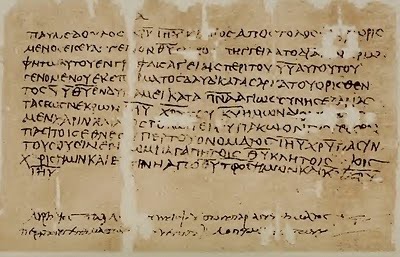
In what is perhaps the oldest preserved persuasive explanation of the Christian faith, the author gives us a glimpse of the issues facing the 2nd-century inquirer. Written in an age where Christians had little political agency and were seen as irrelevant, extreme, ill-informed, and irrational, we are given a methodology for identifying Christians that is clear, concise, challenging, and contextually relevant to our 21st-century post-Christian moment. Despite the absence of direct Scripture references, the careful reader will identify a steady stream of New Testament allusions to the Gospels and Epistles.
As we enter the new year, we will do well to equip ourselves with the technique and tone of this marvelous work. The very daring will ask themselves how well they measure against the author’s description.
[Last Things]
If you enjoy this newsletter, please share it with a friend. If you want to join a Bible study, discipleship cohort, or reading group, please get in touch!
Faithful Presence exists to provide whole-life discipleship in the whole of life for the whole of the public square. Join us as we seek renewal in politics and the public square by becoming a Supporting Partner.
Find Us On: LinkedIn | Instagram | Facebook | X | YouTube | Apple & Spotify