
1 Peter 3:8-12 The Ethics of Faithful Presence in the Church
[First Things]
Please let us know if you are interested in joining an in-person Washington discipleship cohort or reading group, have a pastoral concern, or are interested in our resources for churches.
Faithful Presence is looking for two interns for the summer. Please reach out to us if you are aware of someone who might fit well.
[The Devo] The Ethics of Faithful Presence in the Chuch
8 Finally, all of you, have unity of mind, sympathy, brotherly love, a tender heart, and a humble mind. 9 Do not repay evil for evil or reviling for reviling, but on the contrary, bless, for to this you were called, that you may obtain a blessing. 10 For
“Whoever desires to love life and see good days,
let him keep his tongue from evil
and his lips from speaking deceit;
11 let him turn away from evil and do good;
let him seek peace and pursue it.
12 For the eyes of the Lord are on the righteous,
and his ears are open to their prayer.
But the face of the Lord is against those who do evil.”
In keeping with Aristotle’s approach to house-tables, Peter has explored relationships for Christians with governing officials, work relationships, and marriage relationships. Each time, Peter has recalibrated and reapplied not only the operation of Christians within these relationships but also revalued those traditionally on the weak side of the power differential by directly addressing bondservants and women.
Of course, not every Christian finds themselves in an employer-employee relationship, nor do they all enter into marriage. Universality of context then comes down to two facets: the fact that all Christians find themselves living within the population of the governed and that they exist in relationship with others. With his opening statement, “Finally,” Peter announces the conclusion of this section of instructions for living differently in relationships that invariably include uneven power differentials and addresses this second universal context: living differently with everyone.
Throughout this study, we have built a case for living in a posture of faithful presence. Now, it seems, is a good time for a working definition. James Davison Hunter is credited with coining the phrase “faithful presence” in his seminal work, To Change the World. There, he states, “a theology of faithful presence means a recognition that the vocation of the church is to bear witness to and be the embodiment of the coming of the kingdom of God.” (page 95, emphasis mine). I would like to modify that just a bit.
Faithful presence is “a method of living in the world, and specifically within the public square, that requires spiritual, emotional, relational, vocational, ideological, cultural, and evangelical formation, so that Christians are equipped to intentionally, appropriately, and steadfastly participate in Christ’s mission of making all things new.” In other words, “faithful presence is whole-life discipleship, in the whole of life, for the whole of the public square.”
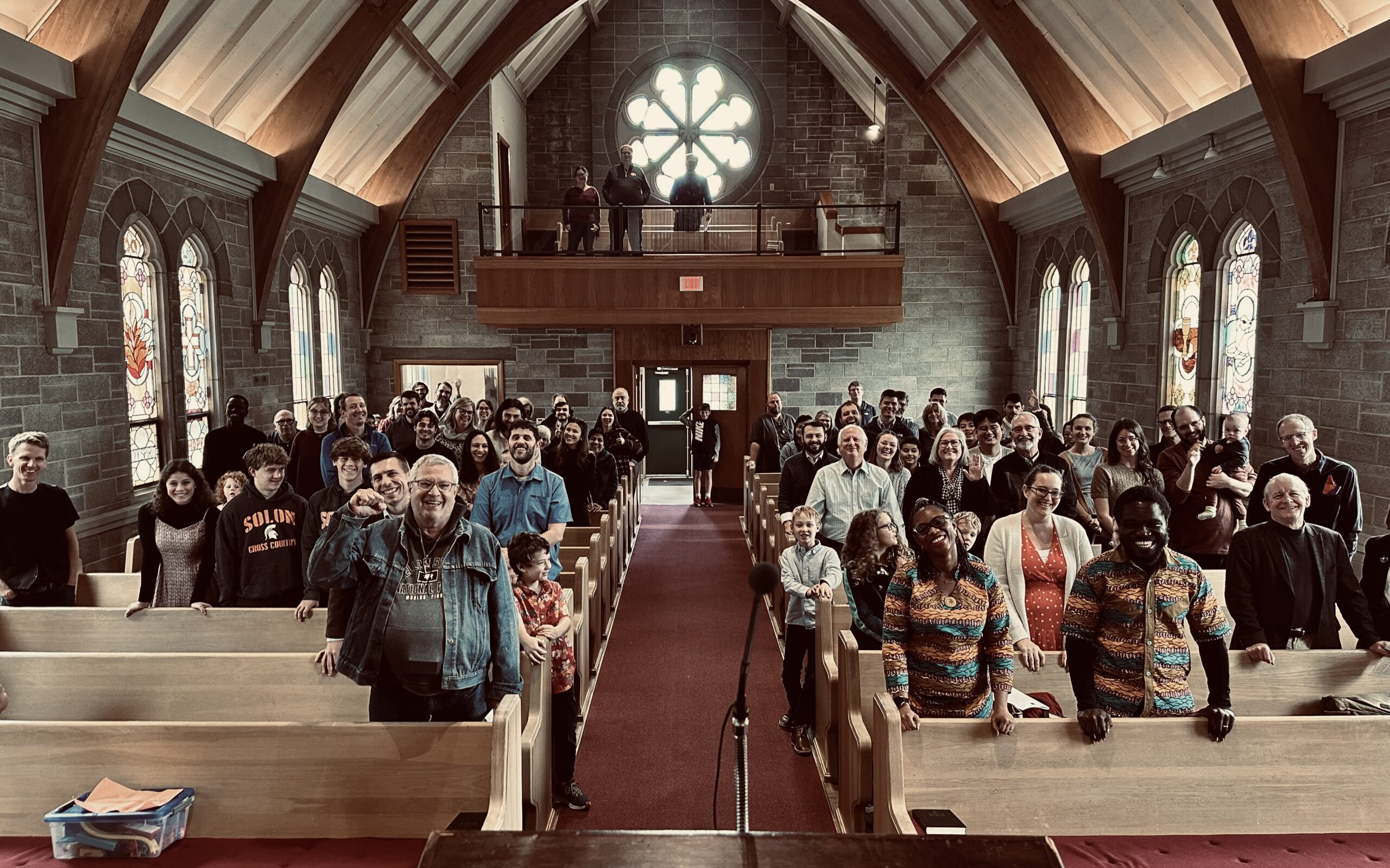
If Christians are going to participate in Christ’s mission of making all things new, they need to start where Christ started - with the church.
Life Within the Church
For nearly two thousand years, the church has attempted to “have unity of mind, sympathy, brotherly love, a tender heart, and a humble mind. Do not repay evil for evil or reviling for reviling, but on the contrary, bless.”
The only one of these instructions that provides the slightest opportunity for empirical measurement is “have unity of mind.” As Christians, we cannot, and should not, have unity of mind with the world. We are guided by God’s revealed word in Scripture rather than natural law, philosophy, cultural trends, individual desires, or political platforms. We will always have dissonance with non-Christians, and accommodation at the expense of truth is not an option. However, a unity of mind regarding the gospel and a mission of God are essential for the church. Because every member of the church is fallen, finite, fragile, and “fragged” (sinned against by others), achieving and maintaining unity is a constant struggle.
Paul has the same concern for the church in Rome,
“Let love be genuine. Abhor what is evil; hold fast to what is good. Love one another with brotherly affection. Outdo one another in showing honor. Do not be slothful in zeal, be fervent in spirit, serve the Lord. Rejoice in hope, be patient in tribulation, be constant in prayer. Contribute to the needs of the saints and seek to show hospitality.
Bless those who persecute you; bless and do not curse them. Rejoice with those who rejoice, weep with those who weep. Live in harmony with one another. Do not be haughty, but associate with the lowly. Never be wise in your own sight. Repay no one evil for evil, but give thought to do what is honorable in the sight of all.
Disunity in the Church
Before Jesus was arrested in the garden of Gethsemane, he prayed for his disciples, including extroverted and boisterous Peter, introverted and gentle John, Matthew the corrupt tax-collector, and Simon the anti-institutional Zealot. His prayer in John 21:20-23 reveals the importance of the unity of mind for his followers,
20 “I do not ask for these only, but also for those who will believe in me through their word, 21 that they may all be one, just as you, Father, are in me, and I in you, that they also may be in us, so that the world may believe that you have sent me. 22 The glory that you have given me I have given to them, that they may be one even as we are one, 23 I in them and you in me, that they may become perfectly one, so that the world may know that you sent me and loved them even as you loved me.
A few years ago, an essay in the National Catholic Register listed the number of different protestant denominations in the United States at 188. Those who reject denominationalism will be pleased to know that on the 500th anniversary of the Protestant Reformation, there were 35,496 separate non-denominational churches. As any pastor who had to navigate the COVID-19 mask discussion knows, there are plenty of opportunities for division within each local congregation over a myriad of issues.
Over the past 2000 years, the church has found plenty of reasons not to be of one mind. While many of those reasons are theological, there are plenty of other motivations for disagreement that lead to division: church worship style, worship venue, building projects, leadership style, children’s ministry, and, of course, political affiliation.
The Work of Unity
This is why Peter follows “have unity of mind” with “sympathy, brotherly love, a tender heart, and a humble mind. Do not repay evil for evil or reviling for reviling, but on the contrary, bless” since all of these attitudes short-circuit acrimonious divisions before they can start.
The next set of verses underscores the point that Peter is making.
“for to this you were called, that you may obtain a blessing. 10 For
“Whoever desires to love life and see good days,
let him keep his tongue from evil
and his lips from speaking deceit;
11 let him turn away from evil and do good;
let him seek peace and pursue it.
12 For the eyes of the Lord are on the righteous,
and his ears are open to their prayer.
But the face of the Lord is against those who do evil.”
The indented section comes from Psalm 34, which, as the title states, is a Psalm of “Of David, when he changed his behavior before Abimelech, so that he drove him out, and he went away.” That preamble directs us to 1 Samuel 21, where it is recorded,
21 Then David came to Nob, to Ahimelech the priest. And Ahimelech came to meet David, trembling, and said to him, “Why are you alone, and no one with you?” 2 And David said to Ahimelech the priest, “The king has charged me with a matter and said to me, ‘Let no one know anything of the matter about which I send you, and with which I have charged you.’ I have made an appointment with the young men for such and such a place. 3 Now then, what do you have on hand? Give me five loaves of bread, or whatever is here.” 4 And the priest answered David, “I have no common bread on hand, but there is holy bread—if the young men have kept themselves from women.” 5 And David answered the priest, “Truly women have been kept from us as always when I go on an expedition. The vessels of the young men are holy even when it is an ordinary journey. How much more today will their vessels be holy?” 6 So the priest gave him the holy bread, for there was no bread there but the bread of the Presence, which is removed from before the Lord, to be replaced by hot bread on the day it is taken away.
7 Now a certain man of the servants of Saul was there that day, detained before the Lord. His name was Doeg the Edomite, the chief of Saul’s herdsmen.
8 Then David said to Ahimelech, “Then have you not here a spear or a sword at hand? For I have brought neither my sword nor my weapons with me, because the king’s business required haste.” 9 And the priest said, “The sword of Goliath the Philistine, whom you struck down in the Valley of Elah, behold, it is here wrapped in a cloth behind the ephod. If you will take that, take it, for there is none but that here.” And David said, “There is none like that; give it to me.”
10 And David rose and fled that day from Saul and went to Achish the king of Gath. 11 And the servants of Achish said to him, “Is not this David the king of the land? Did they not sing to one another of him in dances,
‘Saul has struck down his thousands, and David his ten thousands’?”
12 And David took these words to heart and was much afraid of Achish the king of Gath. 13 So he changed his behavior before them and pretended to be insane in their hands and made marks on the doors of the gate and let his spittle run down his beard. 14 Then Achish said to his servants, “Behold, you see the man is mad. Why then have you brought him to me? 15 Do I lack madmen, that you have brought this fellow to behave as a madman in my presence? Shall this fellow come into my house?”
What this passage reveals is that when David was hungry, outnumbered, alone, and on the run, the LORD of steadfast love and faithfulness rescued David so that the redemptive mission could continue. In Chapter 22, we are told the method of God’s rescue.
22 David departed from there and escaped to the cave of Adullam. And when his brothers and all his father’s house heard it, they went down there to him. 2 And everyone who was in distress, and everyone who was in debt, and everyone who was bitter in soul, gathered to him. And he became commander over them. And there were with him about four hundred men.
After the incidents in Samuel 21, David needed a group of followers whom he could count on. But in what can only be called “standard operating procedure,” the group that the LORD sent him would not have been the group David was expecting. However, it is through the developed unity of “everyone who was in distress, and everyone who was in debt, and everyone who was bitter in soul” that David was able to bring the Promised Land under united rule. The purpose of unity was to be a blessing to those inside and outside the church. In that way, the unity of the church becomes evangelical.
While the Christian community is called to live differently from the world in the way that they interact with each other and with outsiders, the conflict and subsequent suffering that people experience within the church are why they often end up outside of the church. Compounding this issue is the impact on the evangelical effectiveness of the church to those outside of God’s redeeming love.
We will talk more about this in the next lesson.
Application Questions
What do you believe are the biggest challenges to “unity of mind?” How can you address them personally? Corporately?
How does the proposed definition of faithful presence reorient your thinking to life within the church?
In what ways do you believe the church’s disunity contributes to the political disunity and polarization of our country?
[Faithful Prayer]
Cabinet Agency: For Secretary Lutnick and all the servants and leaders at the Commerce Department as they navigate the numerous challenges of creating the conditions for economic growth and opportunity for all communities.
Think Tank, Lobby group, NGO: For the servants and leaders at CTIA, as they “advocate on behalf of America’s wireless industry for legislative and regulatory policies that foster greater innovation, investment, and economic growth.”
Weekly delegation: For the servants and leaders with the congressional delegation of Wyoming, whose state has one of the lowest levels of wireless and broadband coverage in the nation..
Agency News: The staff at the Commerce Department who are working with states and telecommunications providers on the BEAD (Broadband Equity, Access, and Deployment) Program, a project to significantly increase access to high-speed internet access to all Americans over the next five years. The Trump administration recently issued states a 90-day extension to submit proposals for access to a portion of the 42.5 billion dollars allocated for this initiative.
Personal requests:
[The Page, The Pod & The Stack]
→ Read this first → Anthony Bradley’s Substack has a perspective-resetting piece on the misperception that the nerdy kids have all the problems in high school, The Cracks in the Golden Image: Performance, Pressure, and the Pathologies of Young Men: Suicide, School Shooters, and Sexual Deviants
→ Listen to this first → In 2024, Kevin Vanhoozer released Mere Christian Hermeneutics, which won awards from Christianity Today and the Gospel Coalition. While his intended audience was pastors and seminary professors, Vanhoozer’s proposal is a better way of reading Scripture for everyone. An excellent and accessible presentation of his main ideas is available in this video from the More to the Story with Andy Miller III.
Christianity Today has a guest essay (well worth the work of signing up for a free account): The Limits of Open Letters, which addresses our frequent preference for well-penned missives over a faithful presence in the public square.
Pew Research Center has information on the demographic changes in the College of Cardinals since the previous conclave that will influence the selection of the next Pope.
Tom Nelson recently had a piece in Common Good Magazine addressing burnout that many will relate to: Against Burnout: What to Do When What You’re Doing Leaves You Flat, Exhausted, and Ready to Quit.
[What’s Happening?]
This Week
Tuesday, April 29, 10:00 - 11:00 am ET, the Bipartisan Policy Center will host an in-person event, AI at Work: Navigating the Next Evolution of the Labor Market, exploring how AI is already showing up in the labor market, what policymakers and AI developers should keep in mind as they navigate this transition, and what the public should consider as AI becomes more ubiquitous in society.
Wednesday, April 30, 2:00 - 4:30 pm ET, the Urban Institute hosts an in-person Apprenticeship: Industry Driven, Made to Scale, to discuss how national organizations and system reforms can support and further scale this movement, building the next chapter of America’s apprenticeship renaissance.
Wednesday, April 30, the Center for Strategic and International Studies (CSIS) will host an online event, CommonHealth Live! with Dr. Adam Ratner and Dr. Ephrem T. Lemango for a conversation on measles outbreaks in the United States and abroad, bolstering measles vaccination coverage, and the importance of routine immunizations.
Friday, May 2, 12:00 - 1:00 pm ET, Faith & Law’s Friday Forum hosts an in-person event, Able to Succeed: People with Disabilities and the Imago Dei, to discuss first what the Bible says about people with disabilities and how we should view disabilities. In light of this, we will discuss how we should approach public policy that affects people with disabilities. Is the government morally obligated to provide a safety net? What does affording people with disabilities equal opportunity to the pursuit of happiness look like?
Saturday, May 3, 2:00 - 5:00 pm ET, District Wharf hosts the 13th Annual Running of the Chihuahuas presented by Pacifico and emceed by Tommy McFly. The fun-filled and free event features the iconic Chihuahua races, a Pacifico Beer Garden, a DJ, and a giant inflatable Chihuahua for photo opportunities.
Next Week
Tuesday, May 6, 10:00 – 12:45 pm ET, Bipartisan Policy Center will host an in-person event, Advancing Youth Mental Health: Perspectives from Youth and Families, with a panel of youth and caregivers who have experienced the crisis firsthand, to discuss proposed bipartisan policy solutions and why they are urgently needed.
Tuesday, May 6, 2:00 - 4:00 pm ET, Brookings presents an online event, The Sixteenth Annual A. Alfred Taubman Forum on Public Policy: The Future of Public Service to to evaluate recent changes to the civil service and think through what they mean for the future of governance in the United States.
Thursday, May 8, 2:30 - 3:30 pm ET, Cato Institute hosts an online event, Crushing Capitalism: How Populist Policies Are Threatening the American Dream. The forum will discuss “how populist narratives are gaining traction across the political spectrum, claiming that free markets have failed the American middle class.”
Thursday, May 8, 5:00 - 6:15 pm ET, American Enterprise Institute hosts a hybrid event, The American Dream Lecture Series: Conservatives and Culture—A Failure of Imagination with Christopher J. Scalia.
Mother’s Day Weekend!! - Head to the mountains to visit Shenandoah NP and some of the area’s distilleries and wineries, or make your way to the waterfront for brunch.
[Two Thumbs Up: BOOK] “Called to Freedom: Retrieving Liberty in an Age of License,” Brad Littlejohn
On March 23, 1775, Patrick Henry addressed the Second Virginia Convention as they were considering committing their troops to the Revolutionary War. He ended his speech with the statement, “Give me liberty or give me death.” Just over a year later, the words “life, liberty, and the pursuit of happiness” became the foundation of our Declaration of Independence.
In Called to Freedom, Brad Littlejohn (Fellow at the Ethics and Public Policy Center), examines the notions of freedom and liberty in our present culture through a well-honed biblical and theological lens. Leaning heavily on Scripture and standing on the shoulders of C.S. Lewis and Oliver O’Donovan, Littlejohn interrogates current conceptions of liberty through three lenses: spiritual freedom, moral freedom, and political freedom. His assessments and application are as timely as they are pastoral, and expose deeply concerning issues within the church, where the improper pursuit of freedom has resulted in suffering and enslavement.
What makes Called to Freedom uniquely helpful is the author’s specific application of these three lenses to three presently relevant topics: technology, the markets, and religious liberty. Littlejohn’s perception of contemporary American evangelicalism’s hyper-occupation with religious liberty is well worth the price of the work alone. The book is highly recommended for those serving and leading in the public square, and pastors who are equipping their congregations for Christ-centered participation in the public square.
[Last Things]
If you enjoy this newsletter, please share it with a friend. If you want to join a Bible study, discipleship cohort, or reading group, please get in touch!
Faithful Presence exists to provide whole-life discipleship in the whole of life for the whole of the public square. Join us as we seek renewal in politics and the public square by becoming a Supporting Partner.
Find Us On: LinkedIn | Instagram | Facebook | X | YouTube | Apple & Spotify