
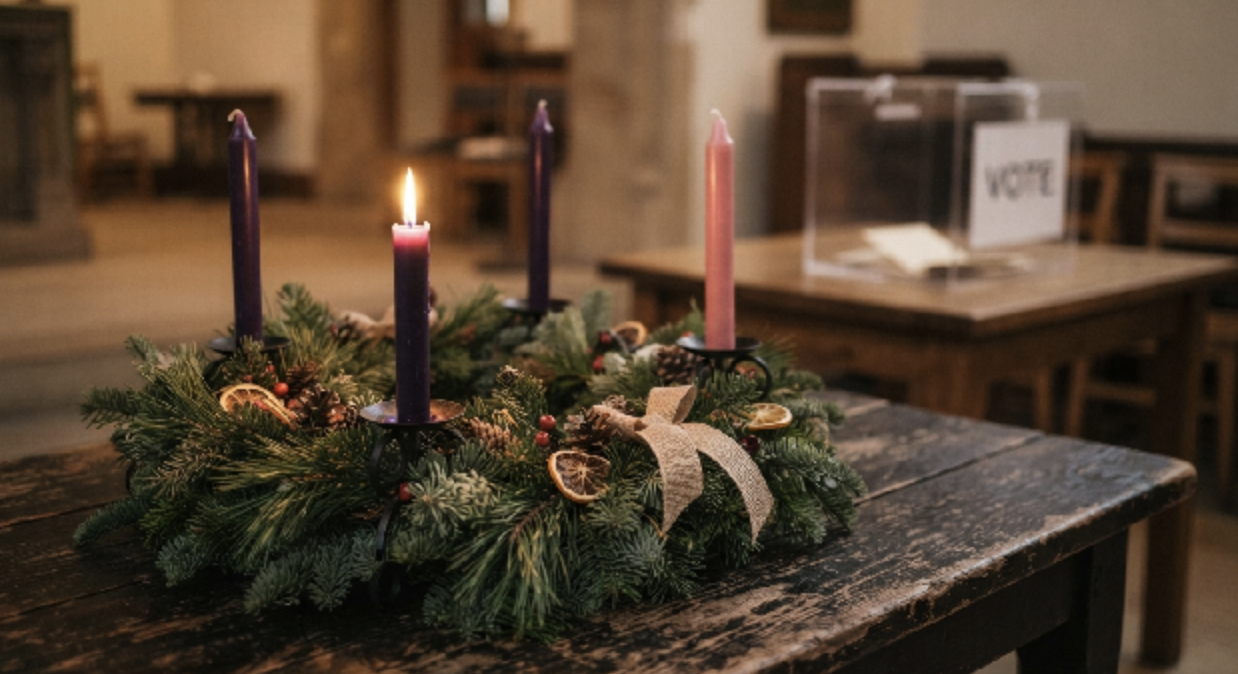
Liturgies of the Church and the Election Cycle
Liturgies, by their nature, are far more than recurring cadences that take place within a church service, or even over the course of the liturgical church calendar. That definition only describes how to recognize them. As James K. A. Smith has helpfully reminded us, liturgies are, in fact, practices of formation: they shape not only what we think but what we love, and, therefore, how we act. As pastors, we lead congregations whose members participate in a variety of regular liturgies. Our calling is not to encourage their withdrawal from these liturgies but to ensure we are grounding them in the right one—the liturgy of the church. Doing so requires a full understanding of the other liturgies in which congregants are participating.
Election cycles, for instance, are very much liturgical, not just in their recurring cadence, but also in their ability to focus and form us, often with congregants mobilized for participation in a mission.
The Implications of the Public Square Liturgy in 1860
After party conventions, campaigning, and his victory in the presidential election of November 1860, Abraham Lincoln was not inaugurated until March 4, 1861. During that time, seven states seceded from the Union. By April, Confederate forces had fired on Fort Sumter in South Carolina, starting the Civil War. Five days later, Virginia joined the Confederacy, with three other states joining by June to bring the total to eleven. One month later, the first major battle of the Civil War was fought just outside Manassas, VA. In that battle, nearly 900 were killed, with another 4,000 injured. The following year, during the Second Battle of Bull Run/Manassas, 3,200 more were killed along with an additional 15,000 injured.
My wife and I attend a church in Northern Virginia that, like many in this area, is over 150 years old. Started only two years before the start of the Civil War, in 1859, Greenwich Presbyterian Church is located just five miles from our house, and only seven miles from the Manassas National Battlefield Park. The church property includes a cemetery where soldiers killed in those battles are buried.
Our church also testifies to another aspect of the electoral liturgy of 1860. In addition to the division of states in the Civil War, there was also a division of churches. In December 1861, the Presbyterian churches located in the Confederate States broke away from the national denomination to form the Presbyterian Church in the Confederate States of America, which, after the war, became the Presbyterian Church in the United States (PCUS). They were, sadly, not the first denomination to face a schism related to the issue of slavery. The Methodists had done so in 1844, forming the Methodist Episcopal Church, South, and the Baptists followed in 1845, forming the Southern Baptist Convention, both more than fifteen years before the Civil War. Clearly, political liturgies and church liturgies are not free from interactions with each other.
During the divide, sermons in the Union states focused on the reality that slave lives mattered because all people are created in the image of God. In the Confederacy, conversely, sermons focused on a perceived biblical endorsement of slavery. Churches in the South pointed to a degrading morality of the northern states, which they tied to infidelity to Scripture and rationalism, as churches in the North accused those in the South of using Scripture to legitimize sin. While one side was clearly right about slavery, the liturgies of churches in both the North and the South served to form their members for participation in issues of the public square, including a willingness to kill for their beliefs.
By the end of the Civil War, a total of 620,000 had died, and 450,000 had been injured. Families had been torn apart, property destroyed, economies left in shambles, and many Christians left with serious questions and disillusionment. Even though the Union was reestablished in 1865, the denominational splits would last more than a century, and in some cases would prove permanent. Those that did reunify faced other splits centered on issues of confessional orthodoxy, with the election liturgies contributing to conflicts related to the civil rights movement, the role of women, economic issues, and others.
The Implications of the Public Square Liturgy in 2026
With the midterms over, our country will now gear up for the presidential election of 2028. Very soon, candidates will begin declaring their interest, meeting state filing deadlines, raising money, then hitting the campaign trail ahead of the first caucuses and primaries in early 2028, followed by the rest of the primaries, a national election on the first Tuesday following the first Monday in November, culminating in the inauguration on January 20. Both parties will employ elements of this election cycle as an opportunity for formation and participation.
Over the past several election cycles, sermons in some churches across the United States have emphasized that black lives matter since all people are created in the image of God, the need for greater diversity, equity, and inclusion, and individual freedom of choice regarding abortion and sexuality. Meanwhile, other churches have used their liturgies to highlight degrading cultural morality tied to the liberalization of colleges, universities, and seminaries, the growing prevalence of Marxist and critical theory approaches to economics and social issues, and the need to reclaim masculinity and the historical national Christian identity. Ironically, many orthodox churches whose forebears preached that slave lives mattered now recoil at the phrase “black lives matter,” not because their conviction about the image of God has changed, but because another political liturgy has claimed, and malformed, the words.
Our failure, as pastors, is that the liturgies of our churches, as presented, have not been clear or strong enough to reclaim them. As a result, the liturgies of some churches on both sides have instead malformed their members for a participation in the public square that does not align with Christ’s mission of making all things new, including a desire to achieve the goals of that formation through force if necessary.
In November, liturgically formed voters went to the polls with questions and concerns about data centers and their market implications for energy prices, the availability of potable water, property rights, and property values. They also had many concerns about immigration, potential political corruption, a perceived imbalance of power between the three branches of government, and the impact of foreign policy on the price of food and clothing. The result was a definitive change in the balance of power in Washington.
A Case Study in Inadequate Liturgical Formation
The gap between church liturgy and election liturgy was, perhaps, best seen in the U.S. Senate race in Texas between two openly professed Christians. One publicly questions historic orthodox teaching; the other claims orthodoxy while publicly violating it. Yet each drew enthusiastic support from Christians in the pews.
The first candidate, widely described as a leading voice of the new Christian left, attended seminary and has stated publicly that he does not believe in excluding access to God through the Son, despite Jesus saying “No one comes to the Father except through me” (John 14:6). Additionally, he does not affirm the historic orthodox Christian teaching that marriage is a covenantal union rightly entered into only by one man and one woman (Gen 2:24), denies that gender is assigned by God (Gen 1:27), and is on record as fully supporting elective abortion up to the moment of birth (Ps 139:13–16) in direct opposition to the teaching of the Didache, one of the earliest documents of orthodox Christian practice:
And this is the second commandment of the teaching. 2 Thou shalt do no murder, thou shalt not commit adultery, thou shalt not corrupt boys, thou shalt not commit fornication, thou shalt not steal, thou shalt not deal in magic, thou shalt do no sorcery, thou shalt not murder a child by abortion nor kill them when born, thou shalt not covet thy neighbour’s goods, 3 thou shalt not perjure thyself, thou shalt not bear false witness, thou shalt not speak evil, thou shalt not cherish a grudge. Didache 2:1–3
On the other side, gladly identifying as a member of the Christian right, was a founding member of an evangelical megachurch in Texas, who was indicted on multiple counts of felony securities fraud in 2015, in direct contradiction of the LORD’s instruction on financial dealings (Lev 19:11), before agreeing to a deferment in 2024. A year later, a Texas judge awarded $6.6 million to four former aides in his office whom he fired after they reported him to law enforcement for abuse of power (Deut 24:14; Eph 6:9) and misappropriation of funds (Ezek 22:27). He later dropped his appeal, making the judgment final. His actions preceding these firings were the grounds for 20 articles of impeachment by a vote of 121–23 by the Texas House of Representatives, which ultimately failed to garner the two-thirds majority needed in the Senate to convict. In his personal life, he also acknowledged that he committed adultery, violating Exodus 20:14, which resulted in his wife divorcing him on biblical grounds (Matt 5:32; Matt 19:9).
If the people in our pews can look at either of these men and see a faithful disciple of Christ, then either our liturgies have failed to form them, or they are refusing the truth those liturgies sought to form within them.
The Proper Role of Church Liturgies
As already stated, it is critical that liturgies are ultimately viewed and employed as a means of attunement and formation to the truth of God, and of equipping us to participate in Christ’s mission of making all things new, which is unfolding in the grand narrative of redemption. It is this narrative that the liturgical church calendar seeks to apply to our formation as disciples.
According to the Western church calendar, this year, Advent starts on Sunday, November 29, and will encompass each of the four Sundays prior to Christmas. Interestingly, in America, Advent starts just weeks after voters go to the polls as part of a different liturgy intended to form the electorate to select a leader whom they will follow.
During the liturgies of Advent, churches around the world attune themselves to the impending incarnation of Jesus, who is the Christ. As part of this liturgy, these churches will recite Scriptures that point to the Light shining into darkness (Isa 9:2; Matt 4:16; Luke 1:78–79), the arrival of Immanuel who is God with us (Isa 7:14; Matt 1:23), and the Messiah who comes to deliver his people from slavery and death (Heb 2:14–15).
In the season of Epiphany, the church remembers how Christ used his miracles to offer foretastes of the coming Kingdom in encouraging what is good through turning water into wine for a marriage celebration (John 2:1–11), restoring what is broken in healing many from all manner of ailments (Matt 4:23–24; Matt 8–9; Matt 15:29–31), including death (John 11:43–44), creating what was missing in multiplying fish and bread to feed the hungry (Matt 14:13–21; Matt 15:32–39), and in opposing what is evil through whipping moneychangers in the Temple (John 2:13–17) and defeating Satan (Matt 4:1–11).
During Lent, the period of 40 days (excluding Sundays) before Easter, Christians around the world engage in liturgies developed to form them through pointing to Christ coming on a donkey denoting service rather than a horse denoting political conquest (Zech 9:9; Matt 21:1–11), anxiety-fueled political and religious maneuvering intended to eliminate him from the public square (John 11:47–53), his guiltless suffering in response to righteous behavior (Matt 27:24; Mark 14:55–56; Luke 23:14–15; John 19:4; 1 Pet 2:22–23), his willingness to submit to torture and death that he could have ended at any time (Matt 26:53), and his death as atonement for our sins (Isa 53:5; Acts 8:32–35; 1 Pet 3:18).
Lent ends in the liturgies of Easter, where churches structure their services to proclaim the victory of Jesus over death in the resurrection (Matt 28:1–10), that victory has come despite apparent defeat (Col 2:15), and the assuredness of Christ’s mission of making all things new.
On Pentecost Sunday, the church is reminded of and formed by the truth that we are empowered by the Holy Spirit (Acts 1:8; Acts 2:1–4) to be sent as the Father sent the Son (John 20:21), to participate in Christ’s mission of making all things new (2 Cor 5:17–20; Rev 21:5), to proclaim the excellencies of him who called us out of darkness and into his marvelous light (1 Pet 2:9–12), to make disciples of all nations, teaching them to obey all that he has commanded (Matt 28:19–20), to proclaim liberty to the captives (Luke 4:18), to seek the welfare of the city where God has sent them (Jer 29:7), to endure suffering in response to righteous action (Isa 53:7–9; 1 Pet 3:14–17), to honor the emperor or the electorally chosen leader (1 Pet 2:17), and to maintain a posture of faithful presence in the public square even when every single external data point says that we are failing (John 6:66; Acts 28:30–31; 2 Cor 11:24–26).
Where the liturgies of the public square promise deliverance through victory and domination, the liturgies of the church form us to expect victory through long periods of obedience in the same direction and even apparent defeat, and to stay faithfully present until Christ fully consummates his Kingdom in the new heavens and new earth (2 Pet 3:13; Rev 21:1).
The Goal of Church Liturgies
All of these liturgies revolve around forming us to and for Christ, whom the Apostle Paul describes this way:
15 He is the image of the invisible God, the firstborn of all creation. 16 For by him all things were created, in heaven and on earth, visible and invisible, whether thrones or dominions or rulers or authorities—all things were created through him and for him. 17 And he is before all things, and in him all things hold together. 18 And he is the head of the body, the church. He is the beginning, the firstborn from the dead, that in everything he might be preeminent. 19 For in him all the fullness of God was pleased to dwell, 20 and through him to reconcile to himself all things, whether on earth or in heaven, making peace by the blood of his cross. Col 1:15–20
The author of Hebrews confirms this view of Christ:
1 Long ago, at many times and in many ways, God spoke to our fathers by the prophets, 2 but in these last days he has spoken to us by his Son, whom he appointed the heir of all things, through whom also he created the world. 3 He is the radiance of the glory of God and the exact imprint of his nature, and he upholds the universe by the word of his power. After making purification for sins, he sat down at the right hand of the Majesty on high, 4 having become as much superior to angels as the name he has inherited is more excellent than theirs. Heb 1:1–4
Every election brings us closer to the full consummation of the Kingdom of God, not necessarily through the policies that are adopted, but through the reality that the date of Christ’s return is continuing to draw near.
The culmination of the fullness of his Kingdom is described in Revelation 21:
21 Then I saw a new heaven and a new earth, for the first heaven and the first earth had passed away, and the sea was no more. 2 And I saw the holy city, new Jerusalem, coming down out of heaven from God, prepared as a bride adorned for her husband. 3 And I heard a loud voice from the throne saying, “Behold, the dwelling place of God is with man. He will dwell with them, and they will be his people, and God himself will be with them as their God. 4 He will wipe away every tear from their eyes, and death shall be no more, neither shall there be mourning, nor crying, nor pain anymore, for the former things have passed away.”
5 And he who was seated on the throne said, “Behold, I am making all things new.” Also he said, “Write this down, for these words are trustworthy and true.” 6 And he said to me, “It is done! I am the Alpha and the Omega, the beginning and the end. To the thirsty I will give from the spring of the water of life without payment. Rev 21:1–6
Until then, pastors and church leaders must use church liturgy to form whole-life disciples who are not taken in by anxiety-fueled and exhaustion-producing triumphalism → despair → triumphalism → despair emotional and psychological whiplash created by the political and electoral liturgies of the public square. Properly administered within confessionally evangelical churches of every denomination, these liturgies provide the church an opportunity to produce resilient disciples who are knit together as worshipers, all moving in a long obedience in the same direction and providing a visible alternative to many alternative liturgies.
Properly attuned and formed by the liturgies of the church calendar, servants and leaders are deployed to work within and for the public square through offering foretastes of the coming Kingdom. Unlike Christ’s miracles, which brought justice, mercy, and healing, our efforts will always prove more proximate than ultimate. Nonetheless, our liturgically grounded support and efforts on behalf of widows and orphans (Exod 22:22; James 1:27), the disabled (Lev 19:14; Luke 14:13), the sojourner (Lev 19:33–34; Deut 10:18–19), the oppressed worker (Deut 24:14–15; James 5:4), the unborn (Jer 1:5; Luke 1:41–44), the dying (Ps 31:15; Matt 25:36), and the sexually exploited (Joel 3:3; 1 Tim 1:10) are the proper fruit of that formation. Fruit is also borne when Christians advocate for policies that curtail and punish individuals and institutions who take advantage of, and even create, those same groups (Isa 1:17; Isa 10:1–2).
The political liturgies of the 2028 election are already beginning, ready to malform disciples in the public square. As pastors, we must commit ourselves, beginning this Advent, to using the liturgies of the church to form disciples for the public square: whole-life disciples, in the whole of life, for the whole of the public square.
The vision of Faithful Presence is to equip servants and leaders working in our nation’s capital to flourish as they participate in Christ’s mission of making all things new. Support this ministry and receive additional resources with a supporting partnership.