
HUB, Johns Hopkins University (2024)
Living Differently with “Enemies”
43 “You have heard that it was said, ‘You shall love your neighbor and hate your enemy.’ 44 But I say to you, Love your enemies and pray for those who persecute you, 45 so that you may be sons of your Father who is in heaven. For he makes his sun rise on the evil and on the good, and sends rain on the just and on the unjust. 46 For if you love those who love you, what reward do you have? Do not even the tax collectors do the same? 47 And if you greet only your brothers, what more are you doing than others? Do not even the Gentiles do the same? 48 You therefore must be perfect, as your heavenly Father is perfect. Matt 5:43-48.
“The House Republicans are not the enemy. They are the opposition. The enemy is the Senate.”
Often attributed to Sam Rayburn (D-TX), who served in the House of Representatives from 1913-1961, this quote has been repeated with partisan and chamber contextual changes for decades. This comment points to an aspect of the human condition that goes back to the Fall — the inclination of the heart to find someone to think of as the enemy. Once they are seen as an enemy, we can hate them.
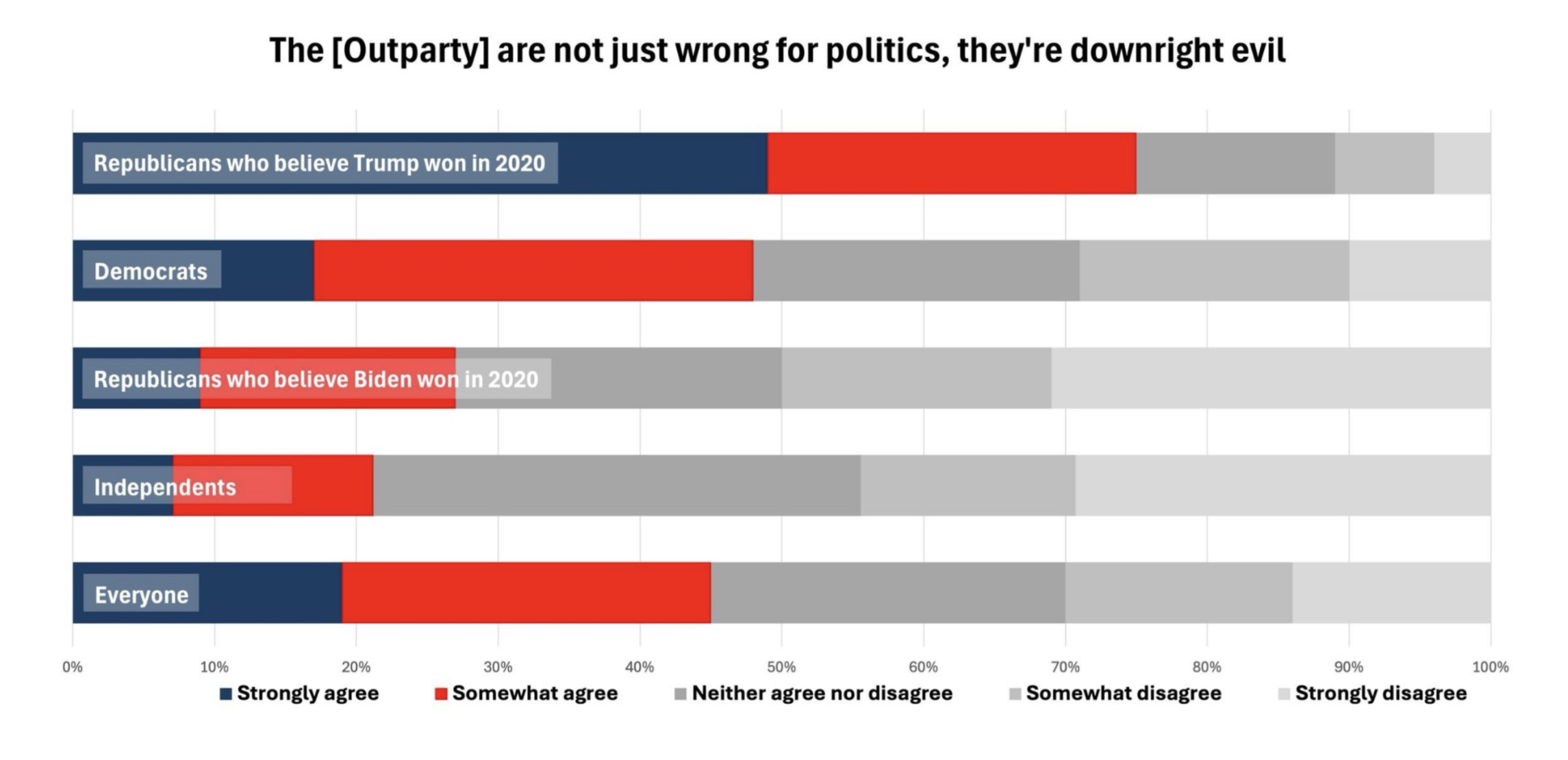
A recent New York Times/Siena poll found that 22% of Democrats and 20% of Republicans viewed members of the other party as “the enemy” rather than the opposition. This, of course, is both confirmed and encouraged by political ads. As we enter the final week of the 2026 midterm campaigns, ads are running that declare one opponent “an enemy of women,” another “an enemy of the people,” another “an enemy of the American worker,” and another “an enemy of freedom.” The public square is increasingly becoming, in some ways, a public forum for the rhetoric of enemy-making and hatred-confirmation.
Confirming the Truth
When people are on the weak side of a power differential it is fuel for the fire of enemy-making and hatred. Jesus is speaking into just such a context. As he speaks, his audience is filled with people who already see others as the enemy. Many Jews see the occupying forces and leaders (the Gentiles) as the enemy, many working-class Jews see the tax collectors as the enemy, and the Zealots (a Jewish sect of which Simon the Zealot was a member) certainly saw Roman collaborating Jewish leadership as the enemy. Yet Jesus moves away from the language of radicalization and toward the language of love.
Continuing his “You have heard it said…but I say” device, Jesus first connects his listeners to Scripture that is a regular part of their lives. The first is a passage from a book that describes in detail the means and method of worship for God’s people.
19 And the LORD spoke to Moses, saying, 2 “Speak to all the congregation of the people of Israel and say to them, You shall be holy, for I the LORD your God am holy.
17 “You shall not hate your brother in your heart, but you shall reason frankly with your neighbor, lest you incur sin because of him. 18 You shall not take vengeance or bear a grudge against the sons of your own people, but you shall love your neighbor as yourself: I am the LORD. Lev 19:1-2, 17-18.
Just in case the slaves who had been redeemed out of bondage in Egypt forgot that message after wandering in the desert for forty years, Moses reminds them how they are supposed to live in the Promised Land.
9 “When you come into the land that the LORD your God is giving you, you shall not learn to follow the abominable practices of those nations. 10 There shall not be found among you anyone who burns his son or his daughter as an offering, anyone who practices divination or tells fortunes or interprets omens, or a sorcerer 11 or a charmer or a medium or a necromancer or one who inquires of the dead, 12 for whoever does these things is an abomination to the LORD. And because of these abominations the LORD your God is driving them out before you. 13 You shall be blameless before the LORD your God, 14 for these nations, which you are about to dispossess, listen to fortune-tellers and to diviners. But as for you, the LORD your God has not allowed you to do this. Deut 18:9-14.
These two passages make clear that the people of God were called to love, not hate, their brother, to live differently from those around them, and, most importantly, “You shall be holy, for I the LORD your God am holy” (Lev 19:2) and “You shall be blameless before the LORD your God” (Deut 18:13).
Rejecting False Assumptions
Interestingly, the phrase “hate your enemy” does not occur in the Old Testament, anywhere. The closest phrase is from Psalm 139:19-24.
19 Oh that you would slay the wicked, O God!
O men of blood, depart from me!
20 They speak against you with malicious intent;
your enemies take your name in vain.
21 Do I not hate those who hate you, O Lord?
And do I not loathe those who rise up against you?
22 I hate them with complete hatred;
I count them my enemies.
23 Search me, O God, and know my heart!
Try me and know my thoughts!
24 And see if there be any grievous way in me,
and lead me in the way everlasting!
But it is important to remember that many Psalms are depicting the way that we pray as those experiencing the effects of the Fall, not as doctrinal lessons. Here, the psalmist’s hatred is not a command to obey but a prayer to offer, and importantly, he does not end by acting on it but by asking God to search his own heart for “any grievous way in me.” See the full text of Psalm 73 as an example.
Many scholars believe that the “hate your enemy” reference comes from parts of the developed Jewish traditions and teaching, including the Qumran writings (Dead Sea Scrolls), which were lived out by the Essenes, another breakaway sect, during the first century. These teachings built upon Israel as distinctive and other and intensified that into hatred of those who were not part of the redeemed people of God.
Practice Makes Perfect
The problem that we, as Christians, have and share with the original audience of the Sermon on the Mount, and even the people about to enter the Promised Land, is not that we are not hating the right people. It is that we are not living as the righteous people of God. There is, often, little difference between us and those who have not been redeemed by grace.
The failure of God’s people to live as those pursuing holy and blameless lives, and to instead embrace many of the sins of those around them, led to the fall of the Southern Kingdom and their exile in Babylon at the hands of an empire that embraced and practiced much of what was forbidden by God. Yet, rather than instructing his people in subversion and underground warfare, the Prophet Jeremiah gives them a message from the God who rescued them out of a similar kingdom centuries earlier.
It said: 4 “Thus says the LORD of hosts, the God of Israel, to all the exiles whom I have sent into exile from Jerusalem to Babylon: 5 Build houses and live in them; plant gardens and eat their produce. 6 Take wives and have sons and daughters; take wives for your sons, and give your daughters in marriage, that they may bear sons and daughters; multiply there, and do not decrease. 7 But seek the welfare of the city where I have sent you into exile, and pray to the LORD on its behalf, for in its welfare you will find your welfare. 8 For thus says the LORD of hosts, the God of Israel: Do not let your prophets and your diviners who are among you deceive you, and do not listen to the dreams that they dream, 9 for it is a lie that they are prophesying to you in my name; I did not send them, declares the LORD. Jer 29:4-9.
The Babylonian Captivity might be better called the Babylonian Retraining because that more fully reflects what was occurring during that time. God’s people were relearning how to live differently as God’s people regardless of where they were actually living. When they returned to Israel, they would return not as conquerors but as subjects of another empire living on the weak side of a power differential.
Therefore, the perfection Jesus calls for is not flawlessness but wholeness: loving as the Father loves, who sends sun and rain on the evil and the good. Exile was where God’s people practiced that kind of holiness, seeking the welfare of the very city that had conquered them.
Living as Sons
The call to live differently is made clear in the two rhetorical questions that Jesus asks.
46 For if you love those who love you, what reward do you have? Do not even the tax collectors do the same? 47 And if you greet only your brothers, what more are you doing than others? Do not even the Gentiles do the same?
The answer, of course, is “Yes, they do!” That makes Jesus’ point extremely indicting, “Then why do you live the same way as the people you hate?”
We do not know if he was present for the Sermon on the Mount, but shortly after Jesus gives this message he invites someone whom many hated to join his disciples much to the disbelief and anger of another powerful sect.
9 As Jesus passed on from there, he saw a man called Matthew sitting at the tax booth, and he said to him, “Follow me.” And he rose and followed him. 10 And as Jesus reclined at table in the house, behold, many tax collectors and sinners came and were reclining with Jesus and his disciples. 11 And when the Pharisees saw this, they said to his disciples, “Why does your teacher eat with tax collectors and sinners?” 12 But when he heard it, he said, “Those who are well have no need of a physician, but those who are sick. 13 Go and learn what this means: ‘I desire mercy, and not sacrifice.’ For I came not to call the righteous, but sinners.” Matt 9:9-13.
Jesus was bringing together extroverts like Peter and introverts like John, as well as Zealots like Simon and corrupt tax collectors like Matthew. He was gathering the poor, the captives, the blind and the oppressed (Luke 4), along with the adulterous (John 4) and the Samaritans (John 4), the Gentiles of the Roman army (Matthew 8) and the Pharisees (John 3, 7, 19). Jesus, in other words, gathered a foretaste of people from every tongue, tribe, and nation and instructed them to love one another, even before those people became full disciples.
This is the second time in his sermon that Jesus uses the phrase “sons of God.” In the first, he said, “Blessed are the peacemakers, for they shall be called sons of God” (Matt 5:9). This, then, appears as a clear amplification and application of the earlier statement since it is impossible to act as a peacemaker if you see the other with hatred and as your enemy.
For servants and leaders in the public square, we are called to live differently as the sons of God and to remember that no one we interact with during our work or in our community is our true enemy,
For we do not wrestle against flesh and blood, but against the rulers, against the authorities, against the cosmic powers over this present darkness, against the spiritual forces of evil in the heavenly places. Eph 6:12.
Rather, as this passages makes clear, it is we who were once the enemies,
13 But now in Christ Jesus you who once were far off have been brought near by the blood of Christ. 14 For he himself is our peace, who has made us both one and has broken down in his flesh the dividing wall of hostility 15 by abolishing the law of commandments expressed in ordinances, that he might create in himself one new man in place of the two, so making peace, 16 and might reconcile us both to God in one body through the cross, thereby killing the hostility. Eph 2:13-16.
As Christians serving and leading in the public square, we are charged not to double down on hatred, but on love seen in living differently as representatives of the gospel.
Application Questions:
- If tax collectors and Gentiles also love those who love them, in what ways does your speech about political opponents look no different from the culture around you?
- Who in your work or community have you quietly begun to see and treat as “the enemy” rather than someone with an opposing political view? What would it look like to not only pray for them by name this week but also begin treating them differently?
- Like the exiles in Babylon, where has God placed you to seek the welfare of people and institutions you might rather resist, and what is one concrete way you can do that?
Faithful Presence exists to provide whole-life discipleship in the whole of life for the whole of the public square. Join us as we seek renewal in politics and the public square by becoming a Supporting Partner.
Find Us On: LinkedIn | Instagram | Facebook | YouTube | Apple & Spotify