
1 Peter 4:7-11 "Waiting for Christ Differently" (Part 2 of 3)
[First Things]
-
Our new Faithful Presence Podcast series, “Thinking Deeply,” is underway with new episodes from Jamie Dangers on the pro-life initiative post-Dobbs, and Dr. Dean Weaver on the realignment of churches and denominations. New episodes every Thursday.
-
Please let us know if you are interested in joining one of our in-person Washington discipleship cohorts or reading groups that start in September. Cohorts are forming in Crystal City, near the EEOB, L’Enfant Plaza, and the Folger Shakespeare Library.
-
Faithful Presence welcomes Jen Ilchishin as our new Director of Partnerships to assist with resourcing churches with content and managing our grant application process.
[The Devo] Waiting for Christ with Earnest Love
7 The end of all things is at hand; therefore, be self-controlled and sober-minded for the sake of your prayers.8 Above all, keep loving one another earnestly, since love covers a multitude of sins. 9 Show hospitality to one another without grumbling. 10 As each has received a gift, use it to serve one another, as good stewards of God’s varied grace: 11 whoever speaks, as one who speaks oracles of God; whoever serves, as one who serves by the strength that God supplies in order that in everything God may be glorified through Jesus Christ. To him belong glory and dominion forever and ever. Amen. 1 Peter 4:7-11
As the earthly ministry of Jesus was coming to an end, one of the primary questions of the disciples was the timing of Jesus fully establishing the kingdom that he had spent the previous three years talking about.
3 As he sat on the Mount of Olives, the disciples came to him privately, saying, “Tell us, when will these things be, and what will be the sign of your coming and of the end of the age?” 4 And Jesus answered them, “See that no one leads you astray. 5 For many will come in my name, saying, ‘I am the Christ,’ and they will lead many astray. 6 And you will hear of wars and rumors of wars. See that you are not alarmed, for this must take place, but the end is not yet. 7 For nation will rise against nation, and kingdom against kingdom, and there will be famines and earthquakes in various places. 8 All these are but the beginning of the birth pains. Matthew 24:3-
After the Resurrection and just before his Ascension, the disciples inquired again,
6 So when they had come together, they asked him, “Lord, will you at this time restore the kingdom to Israel?” 7 He said to them, “It is not for you to know times or seasons that the Father has fixed by his own authority. 8 But you will receive power when the Holy Spirit has come upon you, and you will be my witnesses in Jerusalem and in all Judea and Samaria, and to the end of the earth.” 9 And when he had said these things, as they were looking on, he was lifted up, and a cloud took him out of their sight. 10 And while they were gazing into heaven as he went, behold, two men stood by them in white robes, 11 and said, “Men of Galilee, why do you stand looking into heaven? This Jesus, who was taken up from you into heaven, will come in the same way as you saw him go into heaven.” Acts 1:6
It’s hard to blame them for wondering when Jesus would return and fulfill his promises of complete and lasting restoration. It’s even harder to imagine what they must have been thinking when he disappeared from their midst without even a hint of how long they would have to wait.
The Essential Nature of Love
In addition to all the theological aspects of their questions, there were also the emotional and relational implications of waiting. Peter was going to have to figure out how to deal with John’s soft-spoken demeanor, and the disciples were going to have to keep on dealing with Peter’s impulsive nature. Simon the Zealot and Matthew the Tax-Collector were going to have to continue doing ministry alongside one another. The whole of the disciples were going to have to figure out how to pastorally care for all the new converts to Christianity: the Samaritans, the Gentiles, Roman soldiers, merchants, bondservants, the poor and needy, and people who are just hard to love.
Jesus, of course, was concerned about this too, and, because praying is always the most you can do, Jesus took that concern to his Father in the garden while he awaited his own betrayal, arrest, trial, and death.
20 “I do not ask for these only, but also for those who will believe in me through their word, 21 that they may all be one, just as you, Father, are in me, and I in you, that they also may be in us, so that the world may believe that you have sent me. 22 The glory that you have given me I have given to them, that they may be one even as we are one, 23 I in them and you in me, that they may become perfectly one, so that the world may know that you sent me and loved them even as you loved me. John 17:20–23.
This is a passage that we have considered before, and for good reason. Love is a critical component of his followers fulfilling the mission of God. Differences in cultural background, personality, political views, gender, age, and education can all serve as fodder for conflict and division. Because of this, Jesus prays that their love for God will manifest itself through their love for one another, so that the world will know that God loves them. Without love for one another, missional effectiveness is nearly impossible.
In another of our frequently referenced passages in Leviticus, we read the imperative call to “love your neighbor as yourself,” which is at the heart of following and identifying with God. This is the point Peter wants to drive home to his readers, who are also waiting for full restoration.
The Earnest Nature of Love
The word translated earnestly in this passage carries an inseparable two-fold meaning that involves both constancy and intensity. Perhaps Peter includes this because of his own attempts to set limits on loving his neighbor, when, in Matthew 18, he asked Jesus how often he should forgive someone who sins against him. Although Peter attempted to set the bar high at seven, Jesus responds that seventy times seven is closer to the mark. In looking to draw a line where “loving others as yourself” might run itself out, Peter is exposed as loving insufficiently. In other words, Peter understands that the longer he has to wait for Jesus to return, the longer (and more often) he has to love and forgive. As a result. Peter’s encouragement to the elect exiles is that they manifest the same love for each other that Jesus had shown Peter, despite his frequent blunders and even denial of Jesus in the hours before his death.
It is one thing to love continually, but another to do so with intensity. Peter is not commending “one step above tolerance” but a love that pursues despite distance, endures despite exhaustion, and overcomes despite difficulty. Throughout their unspecified period of waiting, Peter is calling them to an intensity of love that does not give up on the other person. He is doing so with good reason, “since love covers a multitude of sins.”
To Maintain Relationships
Jewish readers in the audience would have heard echoes of Proverbs 10:12, “Hatred stirs up strife, but love covers all offenses.” And, because this little nugget was so important to community flourishing, it is repeated in Proverbs 19:11, “Good sense makes one slow to anger, and it is his glory to overlook an offense.” The Proverbs were given to the Old Testament people as a guide for daily living in community so that they could live with one another and also draw others into the people of God. The clear teaching here is, “Don’t make everything an issue.”
In writing to the conflict-ridden church in Corinth, Paul writes,
4 Love is patient and kind; love does not envy or boast; it is not arrogant 5 or rude. It does not insist on its own way; it is not irritable or resentful; 6 it does not rejoice at wrongdoing, but rejoices with the truth. 7 Love bears all things, believes all things, hopes all things, endures all things. 8 Love never ends. 1 Corinthians 13:4–8.
That verse is read at most weddings. My wife and I just celebrated 35 years of marriage. When we married, we had no idea what joys or hardships awaited us. We were also not fully prepared for the hard work and commitment required for loving each other through discovering differences and disagreements. Marriage is a covenantal agreement to earnestly love one another “for better or worse, for richer and poorer, in sickness and in health.” Marriage, of course, is exactly how the Bible describes Christ’s earnest love relationship for his people.
The public square has a way of turning differences and disagreements on policy positions into conflict and even hatred. Bill Bishop, in his book The Big Sort (2009), has pointed out that we are intentionally moving into states and counties where the people are more like us, and that the list of specifics we are looking for is growing to include party affiliation. What this reveals is that, while we wait for Christ’s return, it is easier for us to move than to love.
As America nears its 250th anniversary of the land that values the virtues of life, liberty, and the pursuit of happiness, it seems as though the virtue of patience with each other is wearing out. But Christians, especially those serving and leading in the public square, are called to earnestly love those Christians with whom we do not agree, even if they are working to advance an opposing policy position. In our offices, our earnest love for the impulsive or painfully methodical coworker is not just good for the office; it is good for Christ’s mission of making all things new while we await his return.
To Reconcile Relationships
Again, those with Jewish ears would have made a connection to the Old Testament, perhaps Psalm 32:1, “Blessed is the one whose transgression is forgiven, whose sin is covered.” This is because Peter is not just advocating that the dislocated Jewish Christians now living in Asia Minor show love towards each other and the Gentiles who are increasingly joining their number; he is pointing them to consider their position with God.
Peter is driving home the very gospel which Jesus had declared,
"For God so loved the world, that he gave his only Son, that whoever believes in him should not perish but have eternal life." John 3:16
“Greater love hath no man than this, that a man lay down his life for his friend.” John 15:13
The blood of Christ, shed for us out of love, covers our sins. And not just our past sins, but those we commit while we wait for his return. The good news of the gospel is that the longer we wait for Christ’s return, the more we come to understand and appreciate how Christ’s love covers a multitude of sins. As a result, our earnestly loving one another, as Peter has learned from experience, is fueled by our understanding of the Father’s love for us as demonstrated through his own Son.
Application questions
Read the Parable of the Good Samaritan in Luke 10. How would you apply this passage on loving earnestly to the lawyer?
Considering Peter’s attempt at qualifying love, what mental exercises and actions do you find yourself taking to avoid having to earnestly love certain people?
How does this passage reorient your thinking on loving earnestly while you wait for Christ’s return?
[Faithful Prayer]
-
Cabinet Agency: For White House Chief of Staff Susie Wiles, and the servants and leaders who comprise the White House senior staff, including his policy advisors, speechwriters, and close administrative staff.
-
Think Tank, Lobby group, NGO: For the servants and leaders at Susan B. Anthony Pro-Life America as they develop and advocate for pro-life positions nationally and in all 50 states.
-
Weekly delegation: For the servants and leaders in the congressional delegation of Alaska, where President Trump recently met with President Putin in hopes of ending the war in Ukraine.
-
News events: For everyone at the White House, State Department, Department of Defense, and in Congress, who have been, and are continuing to work on bringing an end to the war in Ukraine. For the protocol officers and negotiators who are interacting with President Putin and his staff, President Zelenskyy and his staff, and the leaders of numerous European nations and their staff.
-
Personal requests: For two couples on a week-long vacation. For a senior-level Hill staffer feeling the weight of getting the language right in an important piece of legislation, they are authoring due to the potentially dire consequences of inadequate or improper guidelines. For someone stepping into a new high-profile role with a Washington-based regulatory compliance firm. For someone who is temporarily commuting from halfway across the country each week to serve in a key agency role, so that their children do not have to relocate from their schools, friends, and church.
-
For Jen Ilchishin and Nichole Rittgers, who are stepping into new roles at Faithful Presence this week.
[The Page, The Pod & The Stack]
-
READ this FIRST → The C.S. Lewis Institute has another brilliant piece from Thiago M. Silva, When Truth is Lost, Goodness Distorted, and Beauty Forgotten, which emphasizes the need for whole-life discipleship in an increasingly post-Christian world.
-
LISTEN to this FIRST → The Devil and the Deep Blue Sea Podcast (from the creators of the hit podcast The Rise and Fall of Mars Hill) will take you back to the Satanic Panic that gripped America in the 1980s and ’90s.
-
Read this Next → Politico has a well-balanced piece on the interconnectedness of AI policy and regulation and the energy industry lobby, ‘Unlike Anything We’ve Seen’: The Energy Industry is Counting on the AI Boom.
-
Comment Magazine has a splendidly relevant essay from Nathan Beacom, Moral Identity Politics: Imagining a form of life freed from fear.
-
Religion & Liberty Online has added another essay on the growing call for a tech exit, “Tech and Teens,” written by Caleb Whitmer.
[What’s Happening?]
This Week
-
Monday, August 18, 1:00 pm to 2:00 pm EDT, The Bipartisan Policy Center hosts an online event, America’s Workforce: Short-Term Pell Unpacked, to discuss how the One Big Beautiful Bill Act expanded Pell Grant eligibility to high-quality, short-term job training programs.
-
Tuesday, August 19, 1:00 PM The Roosevelt Institute Book Club presents: The Right of the People: Democracy and the Case for a New American Founding with Osita Nwanevu.
-
Wednesday, August 20, 1:00 pm - 3:30 pm EDT, Brookings hosts a hybrid event, What Does Well-Being Mean for Black Men and Boys in the US? The panels will present key experiences and research findings from communities nationwide.
-
Thursday, August 21, 12:00-1:45 pm EDT, The Center for Public Justice (CPJ) will host a webinar, The Johnson Amendment: Should Pastors Endorse Political Candidates? The webinar will explore one of the most debated intersections of faith and public life: can and should religious leaders and organizations endorse political candidates from the pulpit or in their official capacities?
-
Thursday, August 21, 3:00 PM to 4:50 PM ET, AEI hosts a hybrid event, The Power of Presence: Sustaining Progress in Reducing Chronic Absenteeism.
-
Thursday, August 21, 6:00 PM to 7:00 PM ET, The Aspen Institute’s Alliance for Social Trust will launch a new webinar series that brings together community leaders, practitioners, corporate partners, and researchers to explore how trust is not just an ideal, but a practice. The first session in the series is Beyond Labels: What Trust Looks Like in Practice.
-
The Live! Concert Series is back for another summer of great music from 12:00 - 1:00 pm EDT weekdays on Wilson Plaza. Next week’s schedule includes:
-
Mon. 8/18: Harold Little & The Pocket Jazz Masters, Jazz
-
Tues. 8/19: Bachelor Boys, Top 40 Cover Band
-
Wed. 8/20: DuPont Brass, Electric Brass Driven Ensemble
-
Thurs. 8/21: Kiti Gartner & The Drifting Valentines, Rockabilly Country
-
Fri. 8/22: Ras Lidj Regg’Go Band, Reggae, Reggae, Dancehall
-
-
Saturday, August 23, is Alexandria’s annual Around the World Cultural Food Festival. Take your taste buds on a global journey with international cuisine from more than 40 different countries, along with cultural performances, artisan vendors, and family-friendly activities — all against the scenic backdrop of the Potomac River.
Next week
-
Thursday, August 28, 12:00 - 1:00 pm ET, Rand presents an online event, The Future of Fentanyl and Other Synthetic Opioids.
-
Friday, August 29, 1:00 pm EDT, The Trinity Forum presents an online conversation on “Blaise Pascal: The Man Who Made the Modern World” with its author, Graham Tomlin, a former bishop in the Church of England.
-
The Live! Concert Series is back for another summer of great music from 12:00 - 1:00 pm EDT weekdays on Wilson Plaza. Next week’s schedule includes:
-
Mon. 8/25 Walker Redds Project, R&B
-
Tues. 8/26 GrooveQuest, 60's, 70's, Dance Music
-
Wed. 8/27 JunkFood, Rock
-
Thurs. 8/28 Brencore Earth, Wind, and Fire Tribute, R&B
-
Fri. 8/29 The Lucini Brothers, Brazilian Jazz Fusion
-
-
Labor Day weekend in D.C. means DC Jazzfest!
-
The National Symphony Orchestra’s FREE annual Labor Day weekend concert returns to the West Lawn of the U.S. Capitol! This year, the NSO performs classics by Duke Ellington, George Gershwin, John Philip Sousa, Wolfgang Amadeus Mozart, and more, led by charismatic conductor Enrico Lopez-Yañez and featuring Grammy–nominated rapper/beatboxer Christylez Bacon. A must-see celebration! This performance is free to attend, no tickets required. Seating is first-come, first-served.
[Two Thumbs Up!] Qull & Crumb at the Folger Shakespeare Library
Those working on the Hill, especially those who need to cross-pollinate with staff working for the other chamber, will enjoy having a great location about halfway between the Senate side and the House side.
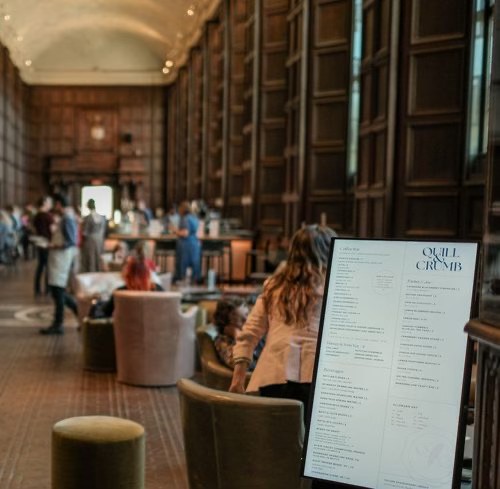
Located on the second floor of the Folger Shakespeare Library, in the Great Hall, is Quill & Crumb. It is a delightful cafe that serves the full complement of coffee drinks, including some signature drinks like Ophelia’s Bloom, which brings together espresso, elderflower & lavender syrup, and pistachio milk. The cafe also offers a generous assortment of tarts, muffins, and pastries to further fuel your morning meeting. Their menu also features several hot and cold sandwiches (the warm ham and brie is a must-have), soups, salads, quiches, and even a few decadent desserts. If you are looking for a quiet place to get a drink without the business of the typical Washington happy hour, Quill & Crumb has you covered with a nice selection of wines, champagne, and even a couple of beers.
Perhaps the most enjoyable aspect of the cafe is the atmosphere. The ornate, floor-to-ceiling, wood walls create a sense of Old World charm in a library dedicated to one of the best writers of any age. The seating is comfy and cozy, but not so crowded that you cannot hear yourself think or worry (too much) about others hearing your conversation.
From their website: The Folger is open Tuesday – Sunday from 11 am – 6 pm, with extended Friday hours until 9 pm. We are closed on Mondays. The café opens at 11 am on days when the Folger building is open. Last call will be 30 minutes before the building closes.
[Last Things]
If you enjoy this newsletter, please share it with a friend. If you want to join a Bible study, discipleship cohort, or reading group, please get in touch!
Faithful Presence exists to provide whole-life discipleship in the whole of life for the whole of the public square. Join us as we seek renewal in politics and the public square by becoming a Supporting Partner.
Find Us On: LinkedIn | Instagram | Facebook | X | YouTube | Apple & Spotify